
WIND-RESISTANT GARDEN LAYOUTS
Mastering the Invisible Force: The Complete Guide to Wind-Resistant Garden Design in Kenya
How to Transform Wind from a Garden Destroyer into a Comfort Creator
Wind-damaged garden with broken plants and fallen branches
Uncontrolled wind doesn't just ruffle leaves—it can break branches, dehydrate plants, and erode soil, turning a beautiful garden into a maintenance nightmare.
🌪️ Introduction: Why Wind Can Quietly Destroy a Beautiful Garden
Wind is one of the most underestimated forces in landscape design. A garden can look flawless on paper—perfectly balanced planting schemes, elegant pathways, stunning focal points—yet still feel uncomfortable, look stressed, or even fail over time because of one critical oversight: poor wind planning.
In coastal and open areas like Kenya’s Mombasa, the coastal plains, and highland regions, wind isn’t an occasional nuisance—it’s a constant, shaping force that demands intentional design. Strong or poorly directed wind doesn’t just create minor inconveniences; it can systematically undermine your entire landscape:
The Destructive Power of Uncontrolled Wind:
🌿 On Plants:
Physical breakage – Delicate stems snap under gust forces, and shallow-rooted species can be uprooted entirely during storms.
Chronic dehydration – Constant airflow evaporates moisture from leaves and soil 10-15x faster than in calm conditions, leading to wilting, leaf scorch, and stunted growth.
Salt burn (coastal areas) – Wind carries salt spray from the ocean, which accumulates on foliage, burning leaves and killing sensitive plants over time.
Pollination disruption – Strong winds can blow away pollen, reducing fruit set in vegetable gardens and orchards.
🪨 On Soil:
Erosion – Wind lifts and carries away topsoil, exposing roots and reducing fertility.
Dust storms – In dry areas, wind can create dust bowls, smothering plants and making outdoor spaces unusable.
Uneven moisture – Wind dries out exposed areas while leaving sheltered spots soggy, creating microclimate chaos.
🪑 On Comfort & Usability:
Unusable spaces – Patios, seating areas, and dining zones become uncomfortable or dangerous when wind speeds exceed 20 km/h (12 mph).
Flying debris – Lightweight items (cushions, umbrellas, garden ornaments) become projectiles in strong gusts.
Chilling effect – Wind amplifies the feeling of cold, making even mild temperatures feel unpleasantly chilly.
🏗️ On Structures:
Vibration damage – Pergolas, trellises, and lightweight fences resonate in wind, leading to fatigue, loosening, and eventual collapse.
Premature aging – Constant wind accelerates wear on wood, metal, and fabric structures.
Noise pollution – Wind whistles through gaps and rattles loose elements, creating irritating sounds.
The Wind-Resistant Philosophy
A wind-resistant garden is not about blocking wind completely—it’s about controlling, slowing, redirecting, and softening airflow so the garden remains functional, comfortable, and beautiful in all conditions.
In Kenya’s diverse climates—from the coastal breezes of Mombasa to the highland gusts of Nairobi—wind is a year-round design factor. The goal isn’t to eliminate wind (which is impossible and often undesirable) but to harness its benefits while mitigating its harm.
This comprehensive guide breaks down wind-resistant landscape design using:
✅ Airflow diagrams to visualize how wind moves through your space
✅ Plant buffering systems for natural, sustainable protection
✅ Structural protection strategies for built solutions
✅ Zoning logic to create comfortable outdoor rooms
🌿 1. Understanding Wind in Landscape Design
Wind is invisible, but its effects are highly visible in a garden. Understanding how wind behaves in your specific landscape is the first step to designing a space that works with—not against—this natural force.
Simple Definition:
Wind in landscape design refers to the movement of air across outdoor spaces and its impact on comfort, plant health, soil stability, and structural integrity.
Unlike static elements like plants or hardscaping, wind is dynamic—it changes in speed, direction, and intensity based on:
Time of day (often strongest in the afternoon)
Season (typically stronger in dry seasons)
Topography (hills, valleys, and buildings affect flow)
Vegetation (trees and shrubs slow and redirect wind)
The Dual Nature of Wind:
Wind can be both a friend and a foe in the garden:
Wind TypeEffectDesign ApproachBest ForCooling WindBeneficial in hot climates; lowers perceived temperature by 5-10°CChannel and enhance airflow toward seating areasPatios, lounges, dining spacesDrying WindHarmful to plants; accelerates evaporation and dehydrationSlow and filter with layered plantingPlant beds, vegetable gardensDestructive WindDamaging; can break branches, uproot plants, or topple structuresDeflect and absorb with dense barriersExposed boundaries, high-wind zonesDirectional WindConsistent prevailing winds (e.g., southeasterlies in Mombasa)Plan permanent windbreaks perpendicular to wind directionProperty edges, long-term plantings
Wind Behavior Diagram:
Wind moves from high-pressure to low-pressure areas, accelerating in open spaces and impacting vulnerable zones.
Pro Tip:
Map your wind patterns before designing. Spend a few days observing:
Which direction does the wind usually come from?
When is it strongest (time of day, season)?
Which areas feel most exposed?
Where does wind cause the most damage?
This information will guide your windbreak placement, plant selection, and zoning.
🌡️ 2. Why Wind Control Is Essential in Gardens
Without intentional wind planning, even a perfectly designed garden can fail functionally. Wind doesn’t just make a space feel uncomfortable—it can actively undermine the health of your plants, the stability of your structures, and the usability of your outdoor areas.
Effects of Uncontrolled Wind:
| Area | Problem | Impact | Solution |
|---|---|---|---|
| 🌿 Plants | Drying, breakage, stress | Reduced growth, wilting, dieback, or physical damage from gusts. Salt burn in coastal areas. | Use wind-resistant species, layer planting, and provide shelter with windbreaks. |
| 🪨 Soil | Erosion and dust movement | Loss of topsoil, nutrient depletion, dusty conditions that smother plants. | Stabilize with groundcovers, mulch, and windbreaks to reduce surface wind speed. |
| 🪑 Seating Areas | Uncomfortable use | People avoid the space, furniture blows around, papers and dishes scatter, chilling effect in mild weather. | Create sheltered zones with pergolas, screens, or dense planting. Orient seating away from prevailing winds. |
| 💧 Water Features | Excess evaporation | Increased water loss, higher maintenance costs, potential damage to pumps from debris. | Place in protected areas, use wind-resistant designs (e.g., sunken ponds), and add barriers to reduce wind speed. |
| 🏗️ Structures | Instability or vibration | Pergolas sway, screens rattle, lightweight structures may fail or wear out prematurely. | Use sturdy, anchored materials. Avoid large, flat surfaces that catch wind. Add windbreaks to reduce pressure. |

Coastal Kenyan garden with palm trees and wind-resistant design
In coastal areas like Mombasa, wind is a constant factor. Proper design turns a potential problem into a comfortable, functional garden that thrives despite strong breezes.
Key Insight:
Wind doesn’t just affect comfort—it shapes the survival of the landscape.
Ignoring wind in your design can lead to:
Plant failure (dehydration, breakage, salt burn)
Soil degradation (erosion, dust storms)
Structural damage (vibration, premature aging)
Unusable spaces (discomfort, flying debris)
Conversely, thoughtful wind control can:
✅ Enhance comfort by creating calm, usable zones
✅ Improve plant health by reducing stress and water loss
✅ Extend the growing season by protecting delicate species
✅ Increase property value by making outdoor spaces more functional and enjoyable
🌪️ 3. Types of Wind in Landscape Environments
Not all wind is the same. Understanding the different types of wind in your garden helps you plan the most effective responses. Each type has unique characteristics that require tailored design solutions.
1️⃣ Prevailing Wind
Definition: Wind that blows consistently from one direction most of the time. In Kenya, this includes:
Southeasterly winds in Mombasa and coastal areas (blowing from the Indian Ocean)
Northeasterly trade winds in highland regions like Nairobi
Seasonal monsoon winds that shift direction with the rainy and dry seasons
Characteristics:
✅ Predictable direction – You can design around it with confidence.
✅ Seasonal consistency – Often follows regular patterns (e.g., stronger in July-August, weaker in April-May).
✅ Local variations – May be influenced by topography, buildings, or vegetation.
Design Response:
Permanent windbreaks – Install dense tree belts or structural barriers on the windward side (the side facing the prevailing wind).
Zoning – Place protected areas (like seating zones) on the leeward side (the side sheltered from the wind).
Plant selection – Choose species that thrive in consistent wind exposure (e.g., casuarina, neem, cypress).
Orientation – Align paths, patios, and plant beds to minimize direct exposure.
Example:
In Mombasa, the prevailing southeasterly winds blow consistently from the Indian Ocean. A well-designed garden would have:
A dense windbreak of casuarina or cypress trees on the southeast boundary.
Seating areas and delicate plants on the northwest side of the windbreak.
Curved pathways to disrupt straight wind flow.
2️⃣ Gusty Wind
Definition:Sudden, unpredictable bursts of wind that can come from any direction. These are common during:
Thunderstorms (especially in Nairobi’s highlands)
Dry season gusts (when temperature differences create turbulent air)
Microbursts (localized, intense downdrafts)
Characteristics:
✅ Irregular and unpredictable – Hard to design for with static solutions.
✅ High peak speeds – Can reach 60-80 km/h (37-50 mph) in short bursts.
✅ Often associated with storms – May come with rain, hail, or lightning.
Design Response:
Layered buffering systems – Use multiple layers of plants (tall trees + shrubs + groundcovers) to absorb and slow gusts.
Flexible structures – Avoid rigid, unanchored elements (like lightweight trellises or umbrellas) that can be damaged or blown away.
Secure all loose items – Ensure furniture, pots, and decorations are weighted, anchored, or stored during gusty conditions.
Wind-resistant materials – Use sturdy, flexible materials (e.g., bamboo, treated wood, or metal) that can bend without breaking.
Example:
In Nairobi’s highlands, afternoon gusts can be strong and unpredictable. A layered hedge of:
Tall cypress trees (primary barrier)
Medium hibiscus shrubs (secondary filter)
Low liriope groundcover (soil stabilizer)
can absorb these bursts without creating turbulence.
3️⃣ Channeling Wind (The Wind Tunnel Effect)
Definition: Wind that is forced through narrow spaces, accelerating in speed and intensity. This is a major issue in urban and suburban gardens, where buildings, fences, and other structures create wind tunnels.
Characteristics:
✅ Accelerated speed – Wind speeds up as it’s squeezed between buildings, fences, or other barriers (can double or triple in speed).
✅ Uncomfortable zones – Creates turbulent, high-speed corridors that are unpleasant to walk through.
✅ Common in urban gardens – Often occurs in side yards, between buildings, or along straight pathways.
Design Response:
Break corridors – Use plantings, screens, or curved pathways to disrupt the wind tunnel.
Redirect flow – Deflect wind away from seating areas using angled barriers (e.g., V-shaped windbreaks).
Avoid straight lines – Curved paths and staggered plantings reduce acceleration.
Widen narrow spaces – If possible, increase the width of corridors to reduce wind speed.
Example:
A narrow side yard (2-3m wide) between a house and a fence can become a wind tunnel with speeds 2-3x higher than in open areas. Solutions include:
Planting a row of dense shrubs (like duranta or bougainvillea) along the fence.
Adding a perforated screen to break up the airflow.
Using a curved path instead of a straight one.
Wind Type Comparison
Prevailing Wind
Consistent direction
Permanent windbreaks
Gusty Wind
Irregular bursts
Layered buffering
Channeling Wind
Concentrated flow
Break corridors
🌬️ 4. Airflow Behavior in Gardens
Wind doesn’t behave uniformly—its speed, direction, and impact change dramatically based on the geometry of your space. Understanding how wind interacts with different garden elements allows you to predict, control, and harness its effects.
🌍 Open Spaces:
Behavior:
Wind speeds increase due to lack of resistance (can be 2-3x faster than in vegetated areas).
Little to no filtering of gusts—wind hits plants and structures at full force.
High exposure for everything in the space.
Design Implications:
Avoid placing sensitive plants (e.g., delicate flowers, young seedlings) in fully open areas without protection.
Use windbreaks to create sheltered pockets within large open spaces.
Group vulnerable plants together and surround them with taller, hardier species.
Consider raised beds to reduce wind impact on soil and low-growing plants.
Example:
A large lawn in an open area can become a windy wasteland for plants. Solution: Plant a perimeter of wind-resistant trees (like casuarina or neem) to create a protected microclimate in the center.
🚶 Narrow Corridors (The Wind Tunnel Effect):
Behavior:
Wind accelerates as it’s squeezed between buildings, fences, or other barriers (this is called the Venturi effect).
Creates uncomfortable movement zones where people feel pushed or pulled.
Can damage plants with repetitive stress (like a tree constantly bending in one direction).
Design Implications:
Avoid straight, unobstructed pathways in windy areas.
Use curved paths or staggered plantings to disrupt airflow.
Add permeable barriers (like lattice screens or hedges) to slow wind speed.
Widen narrow spaces where possible to reduce acceleration.

Wind tunnel effect in a narrow garden pathway
The wind tunnel effect in action: Straight pathways between buildings or fences can accelerate wind speeds by 2-3x, making them uncomfortable and damaging to plants.
🌿 Vegetated Areas:
Behavior:
Wind slows down as it passes through dense plantings.
Turbulence is reduced by layered vegetation (trees + shrubs + groundcovers).
Comfort increases significantly—temperature rises, humidity stabilizes, and noise reduces.
Design Implications:
Use multiple layers of planting for maximum wind reduction (aim for 40-60% speed reduction).
Denser plantings = greater wind protection (but avoid overcrowding, which can lead to disease).
Combine with structures (e.g., pergolas + climbing plants) for enhanced shelter.
Choose wind-resistant species that bend without breaking (e.g., bamboo, casuarina, eucalyptus).
Example:
A mixed border of tall trees (cypress), medium shrubs (hibiscus), and low groundcovers (liriope) can reduce wind speed by 60%, creating a calm, comfortable zone behind it.
Airflow Diagram:
Wind slows and stabilizes as it passes through vegetated areas, creating a calm zone ideal for seating and delicate plants.
🌳 5. Plant Buffering Systems (Natural Wind Control)
Plants are the most effective, sustainable, and aesthetically pleasing way to control wind in a garden. Unlike built structures, they cool the air, improve humidity, provide habitat, and create beauty—all while providing shelter.
Key Principle:
A single plant layer does not stop wind—multiple layers slow, filter, and reshape it gradually, preventing turbulence and creating a comfortable microclimate.
🌲 1. Windbreak Trees (Primary Barrier)
Role: The first line of defense against strong winds. Tall, dense trees reduce wind speed significantly (by 40-70%) and create a sheltered zone on the leeward side (the side opposite the wind).
How They Work:
Height matters – Taller trees block wind at higher levels, protecting a larger area (typically 5-10x their height in the leeward direction).
Density is key – Dense canopies (like cypress or casuarina) provide better protection than sparse trees.
Evergreen vs. deciduous – Evergreens (like neem or eucalyptus) offer year-round protection, while deciduous trees allow winter sun but provide summer shade.
Root systems – Deep-rooted trees (like casuarina) are less likely to uproot in strong winds.
Best Windbreak Trees for Kenya:
| Tree | Height | Wind Reduction | Best For | Maintenance | Notes |
|---|---|---|---|---|---|
| Eucalyptus | 15-30m | 50-60% | Large properties, rural areas | Moderate | Fast-growing; use with caution (can be invasive); high water demand |
| Casuarina | 10-20m | 40-50% | Coastal areas, sandy soils | Low | Drought-tolerant; excellent for windy coastal sites; fixes nitrogen in soil |
| Neem (Azadirachta indica) | 15-20m | 50-60% | Urban gardens, mixed use | Low | Medicinal properties; evergreen; deep roots prevent uprooting; pest-resistant |
| Cypress | 10-25m | 60-70% | Formal gardens, hedges | Moderate | Dense foliage; excellent for tall windbreaks; can be pruned into shapes |
| Markhamia lutea (Nandi Flame) | 8-15m | 40-50% | Urban areas, fast-growing | Low | Native to Kenya; bright yellow flowers; drought-tolerant; attracts pollinators |
| Grevillea | 3-8m | 30-40% | Small gardens, wildlife-friendly | Low | Fast-growing; colorful flowers; attracts birds; drought-tolerant |
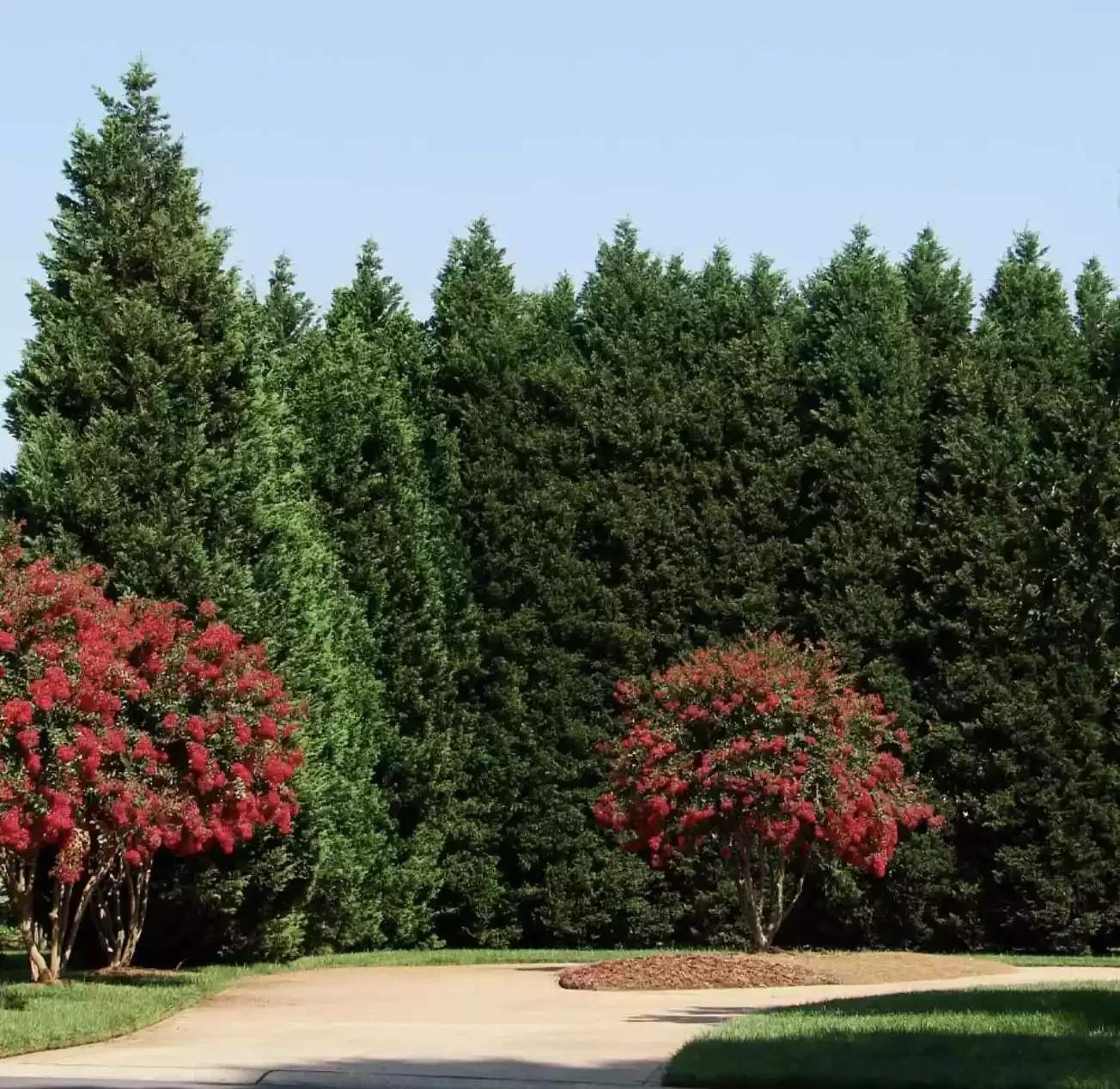
Windbreak trees including cypress providing natural wind protection
Windbreak trees like cypress create a primary barrier against strong winds, reducing speed by 50-70% and creating a sheltered zone for more delicate plants.
Windbreak Tree Planting Tips:
Spacing: Plant trees 1-2m apart for a dense barrier.
Rows: Use 2-3 staggered rows for maximum effectiveness (the second row should be offset from the first).
Orientation: Align windbreaks perpendicular to prevailing winds (e.g., east-west for southerly winds).
Height: The taller the trees, the larger the protected area (typically 5-10x the height of the trees in the leeward direction).
Mix species: Combine fast-growing (e.g., casuarina) and long-lived (e.g., neem) for immediate and lasting protection.
Edge planting: Add shrubs and groundcovers at the base to fill gaps and reduce turbulence.
🌿 2. Shrub Buffers (Secondary Filter)
Role:Medium-height plants that reduce turbulence and filter wind that passes through or around taller trees.
How They Work:
Fill gaps in windbreaks created by sparse tree canopies or seasonal leaf drop.
Reduce turbulence caused by sudden drops in wind speed (a major issue with solid barriers).
Add visual interest with flowering or colorful foliage.
Create wildlife habitat for birds and beneficial insects.
Best Shrubs for Wind Buffers in Kenya:
| Shrub | Height | Wind Reduction | Best For | Maintenance | Notes |
|---|---|---|---|---|---|
| Bougainvillea | 2-4m | 30-40% | Colorful screens, fences, trellises | Moderate | Fast-growing; drought-tolerant; thorny (good for security); vibrant flowers |
| Hibiscus | 1-3m | 20-30% | Flowering hedges, mixed borders | Moderate | Large, colorful flowers; attracts pollinators; needs regular pruning |
| Privet (Ligustrum) | 2-4m | 40-50% | Formal hedges, privacy screens | High | Fast-growing; dense foliage; needs frequent trimming; can be shaped |
| Duranta (Golden Dewdrop) | 2-4m | 30-40% | Ornamental hedges, wildlife gardens | Moderate | Attracts birds; drought-tolerant; thorny; purple flowers in summer |
| Murraya (Orange Jasmine) | 1-3m | 20-30% | Scented gardens, low hedges | Low | Fragrant white flowers; evergreen; low-maintenance; attracts bees |
| Clivia | 0.5-1m | 10-20% | Under trees, shaded borders | Low | Shade-tolerant; orange/red flowers; low water needs; deer-resistant |
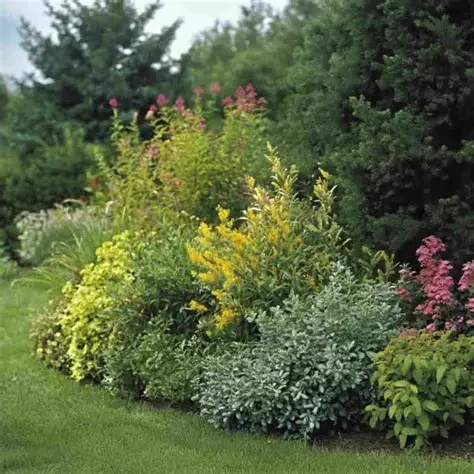
Shrub buffer hedge providing secondary wind protection
Dense shrubs like privet or bougainvillea act as a secondary filter, reducing turbulence and adding beauty to windbreak systems.
🌾 3. Groundcover Stabilizers
Role:Low-growing plants that prevent soil erosion, reduce dust, and stabilize the ground in windy areas.
How They Work:
Hold soil in place with extensive root systems, preventing wind erosion.
Reduce wind speed at ground level, protecting seedlings and delicate plants.
Improve humidity by reducing evaporation from the soil.
Suppress weeds by blocking sunlight to weed seeds.
Best Groundcovers for Windy Areas in Kenya:
| Groundcover | Height | Soil Stabilization | Wind Reduction | Best For | Maintenance |
|---|---|---|---|---|---|
| Asystasia (Chinese Violet) | 0.2-0.5m | Very High | 20-30% | Fast-spreading, flowering groundcover | Moderate |
| Liriope (Lily Turf) | 0.3-0.5m | High | 10-20% | Borders, under trees, mass planting | Low |
| Mondo Grass (Ophiopogon) | 0.1-0.3m | High | 10-20% | Lawn substitute, formal gardens, pathways | Moderate |
| Creeping Fig (Ficus pumila) | 0.1-0.2m | Very High | 30-40% | Walls, containers, hanging baskets, groundcover | Moderate |
| Vetiver Grass | 0.5-1.5m | Very High | 40-50% | Erosion control, hedges, slopes | Low |
Plant Buffering System Diagram
From left to right: Wind → Tree Barrier → Shrub Layer → Groundcover → Calm Garden Zone. Multiple layers slow and reshape wind for maximum comfort.
🌬️ 6. Permeability Strategy (The Most Important Concept in Wind Control)
Here’s a critical principle in wind-resistant design that many gardeners overlook:
A solid wall does NOT stop wind effectively—it creates turbulence.
Why Permeability Matters:
Solid barriers (like brick or concrete walls) block wind abruptly, causing turbulent eddies on the leeward side that can be just as damaging as the wind itself.
Semi-permeable barriers (like hedges or lattice screens) slow wind gradually, reducing both speed and turbulence.
Ideal permeability allows 40-60% of wind to pass through, creating a smooth, controlled airflow rather than a sudden stop and turbulent backflow.
The Science Behind It:
When wind hits a solid barrier, it piles up and spills over, creating a high-pressure zone on the windward side and a low-pressure, turbulent zone on the leeward side. This turbulence can:
Damage plants with repetitive stress (like a tree constantly bending in one direction).
Create uncomfortable microclimates with swirling winds.
Accelerate wear on structures.
In contrast, permeable barriers allow wind to pass through gradually, reducing speed without creating turbulence.
Barrier Types Comparison:
| Barrier Type | Wind Reduction | Turbulence | Effectiveness | Best For | Notes |
|---|---|---|---|---|---|
| Solid Wall | 80-90% | Very High (turbulent eddies) | ❌ Poor | Security, noise reduction (not wind) | Creates strong turbulence; avoid for wind control |
| Dense Hedge | 60-70% | Moderate | ✅ Good | Windbreaks, privacy screens | Better than solid walls; allows some airflow |
| Layered Plants | 40-60% | Low | ✅✅ Best | Natural wind control, microclimate creation | Gradual wind reduction; no turbulence; ecological benefits |
| Perforated Screen | 30-50% | Low | ✅✅ Best | Structural wind control, modern aesthetic | Allows airflow while reducing speed; can be combined with plants |
| Lattice with Climbers | 50-70% | Very Low | ✅✅✅ Excellent | Pergolas, trellises, fences | Combines structural and natural benefits; seasonal adjustment with deciduous vines |
Permeability Diagram:
🧱 Solid Wall
Strong turbulence behind it
🌿 Layered Plants
Smooth airflow reduction
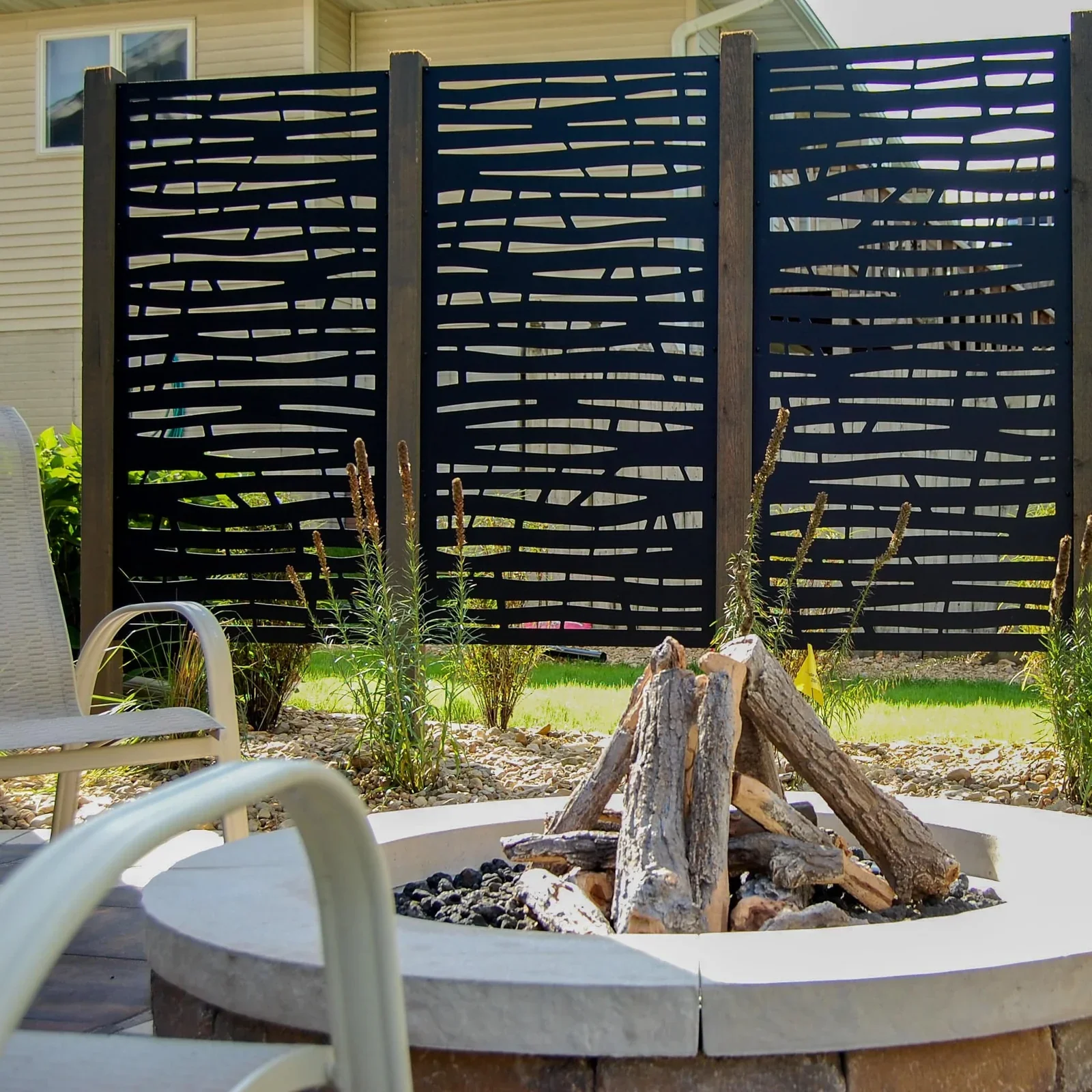
Perforated wood screen providing wind protection while allowing airflow
Perforated screens allow partial airflow (30-50% open), reducing wind pressure without creating turbulence. This wooden slat design is both functional and attractive.
Pro Tip:
For maximum effectiveness, combine permeable barriers with layered planting. For example:
A lattice screen (50% open) + climbing plants (like bougainvillea) can reduce wind by 60-70% while minimizing turbulence.
A hedge of cypress trees (dense but not solid) can reduce wind by 50-60% with little to no turbulence.
🏗️ 7. Structural Wind Protection Systems
While plants are the most sustainable wind control method, built structures are sometimes necessary for immediate, controlled, or stylized protection—especially in:
Urban gardens (where space is limited)
Patios and seating areas (where quick shelter is needed)
Areas where trees aren’t practical (e.g., near buildings or power lines)
1️⃣ Perforated Screens
What they are:
Partially open barriers made from wood slats, metal panels, woven materials, or lattice.
Allow some airflow while reducing wind speed and pressure.
Why they’re effective:
✅ Reduce wind speed by 30-50% without full blockage.
✅ Minimize turbulence compared to solid walls.
✅ Maintain visibility and aesthetic appeal.
✅ Flexible placement – Can be used as fences, dividers, or freestanding panels.
Materials for Perforated Screens:
| Material | Permeability | Durability | Aesthetic | Cost | Notes |
|---|---|---|---|---|---|
| Wood Slats | 40-60% | Moderate (5-10 years) | Natural, warm | $$ | Requires treatment for weather resistance; can be painted or stained |
| Metal Panels | 30-50% | Very High (10+ years) | Modern, industrial | $$$ | Aluminum or steel; powder-coated for durability; can be laser-cut for patterns |
| Woven Bamboo | 50-70% | Moderate (3-7 years) | Natural, rustic | $ | Eco-friendly; biodegradable; may need replacement over time |
| Plastic/Lattice | 60-80% | High (10+ years) | Versatile, modern | $ | Lightweight; UV-resistant options available; can support climbing plants |
| Reed Fencing | 50-60% | Low (1-3 years) | Natural, rustic | $ | Biodegradable; good for temporary windbreaks; may need treatment for longevity |
2️⃣ Pergolas with Side Screening
What they are:
Open-frame structures with added side panels or climbing plants to break wind at seating areas.
Provide overhead shade while blocking horizontal wind.
Why they’re effective:
✅ Define outdoor rooms while protecting from wind.
✅ Maintain openness – Don’t create a closed-in feel.
✅ Flexible – Can be adjustable (e.g., retractable screens or louvered sides).
✅ Support climbing plants for additional wind filtering and aesthetic appeal.
Design Tips:
Side panels should be perforated (not solid) to reduce turbulence.
Climbing plants (like bougainvillea, jasmine, or wisteria) add natural wind filtering and beauty.
Orientation – Place pergolas perpendicular to prevailing winds for best protection.
Height – A 2.5-3m high pergola can protect a seating area of 4-6m in width.
Materials – Use sturdy, wind-resistant materials (e.g., treated wood, aluminum, or steel).
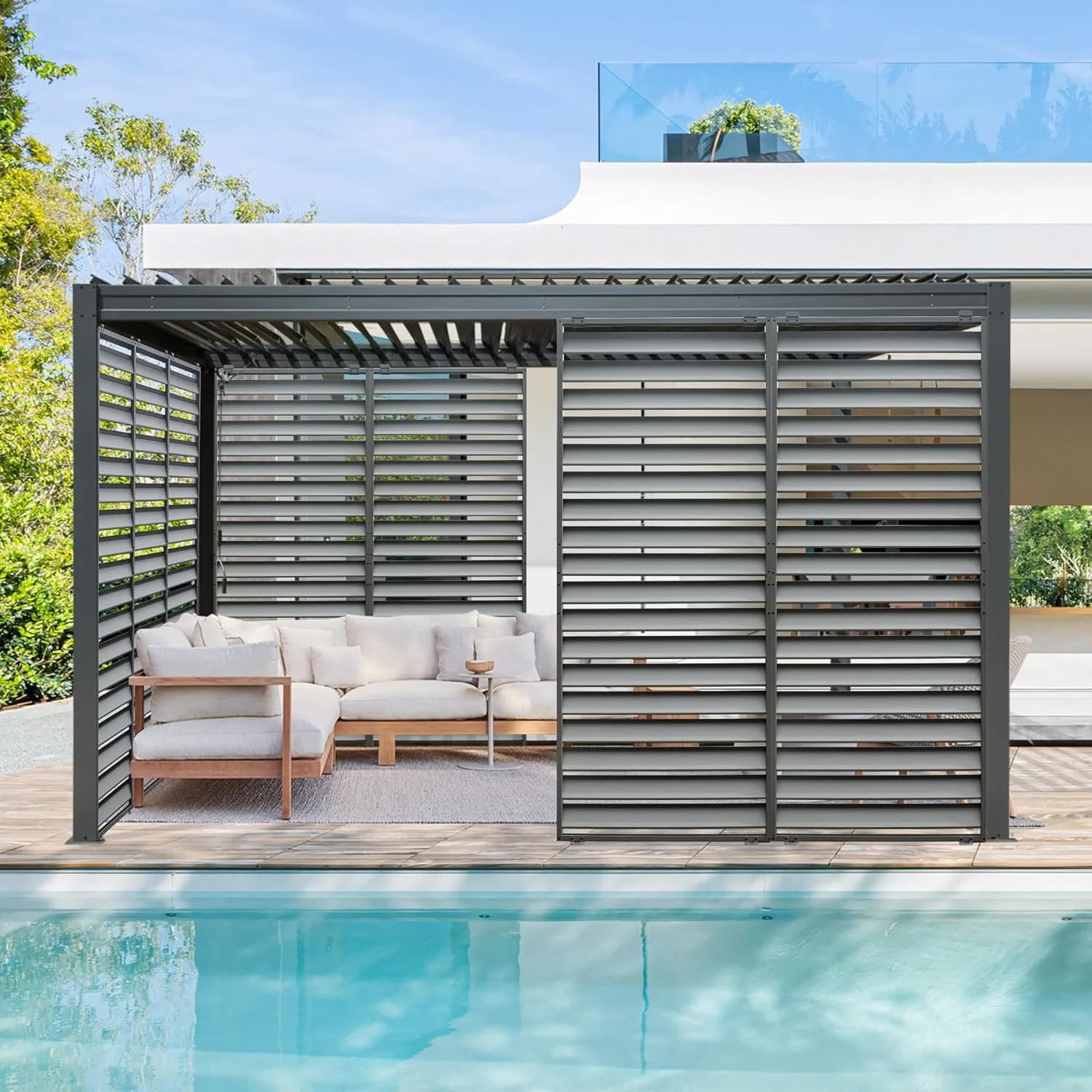
Pergola with side screening providing wind protection for outdoor seating
A pergola with louvered sides creates a sheltered seating area while maintaining an open, airy feel. Climbing plants add natural beauty and additional wind filtering.
3️⃣ Wind Walls (Strategic Placement)
What they are:
Solid or semi-solid barriers used only in extreme exposure zones.
Should never fully seal a space—always allow some airflow.
Why they’re effective (when used correctly):
✅ Strong wind reduction in highly exposed areas (can block 70-90% of wind).
✅ Quick installation for immediate protection.
✅ Can double as privacy screens or noise barriers.
Design Tips:
Use sparingly – Only in areas with extreme wind exposure (e.g., rooftop gardens, coastal edges).
Combine with plants – Climbing vines on wind walls soften the barrier and reduce turbulence.
Height matters – A 1.8-2.4m wall can protect an area 5-10m leeward.
Avoid full enclosure – Always leave gaps for airflow to prevent stagnant, turbulent zones.
Materials – Use durable, weather-resistant materials (e.g., stone, brick, or treated wood).
Structural Protection Diagram:
Perforated screens reduce wind speed by 30-50% while allowing airflow, creating a comfortable seating area.
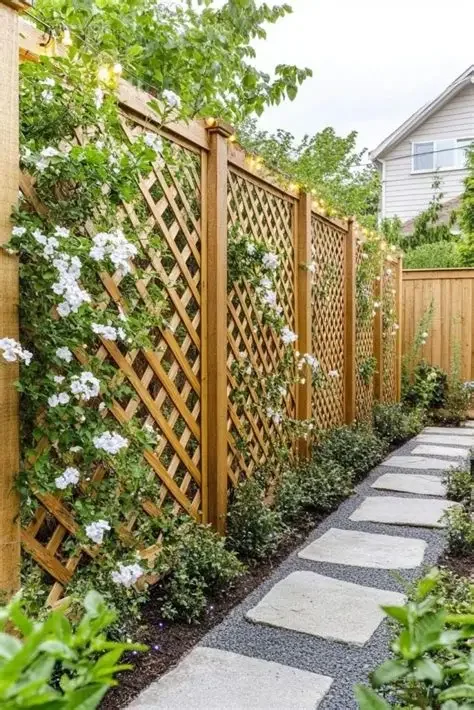
Lattice trellis fence providing wind protection in a garden
Lattice trellises with climbing plants combine structural support with natural wind filtering, creating an attractive and effective barrier.
🗺️ 8. Zoning Strategy for Wind-Resistant Gardens
Good wind design isn’t just about barriers—it’s about where you place spaces in relation to wind patterns. Strategic zoning ensures that each area of your garden serves its purpose without being compromised by wind.
Key Principle:
Place protected zones (seating, dining, lounging) downwind of barriers, and use buffer zones to shield them from wind.
Zone Planning for Wind Control:
| Zone | Wind Exposure | Purpose | Design Strategies | Plant/Structure Examples |
|---|---|---|---|---|
| High Wind Zone | Full exposure | Open lawns, edges of property, exposed areas | Minimal planting; use wind-tolerant grasses; avoid delicate plants | Couch grass, vetiver grass, hardy groundcovers, casuarina |
| Buffer Zone | Reduced exposure | Dense planting belts, transition areas between high and low wind zones | Layered windbreaks; mix of trees, shrubs, and groundcovers; curved or staggered planting | Casuarina, neem, cypress, bougainvillea, hibiscus, privet |
| Protected Zone | Sheltered | Seating areas, lounges, dining spaces, play areas, vegetable gardens | Full wind protection; comfortable microclimate; shade + wind control | Pergolas with screens, dense hedges, climbing plants, shade sails |
Zoning Diagram:
🌬️ Wind Edge
Full exposure
🌿 Buffer Zone
Dense planting belts
🏡 Calm Core Zone
Sheltered seating
Wind-resistant zoning: Wind Edge → Buffer Zone → Calm Core Zone. This creates a gradient of protection for maximum comfort.
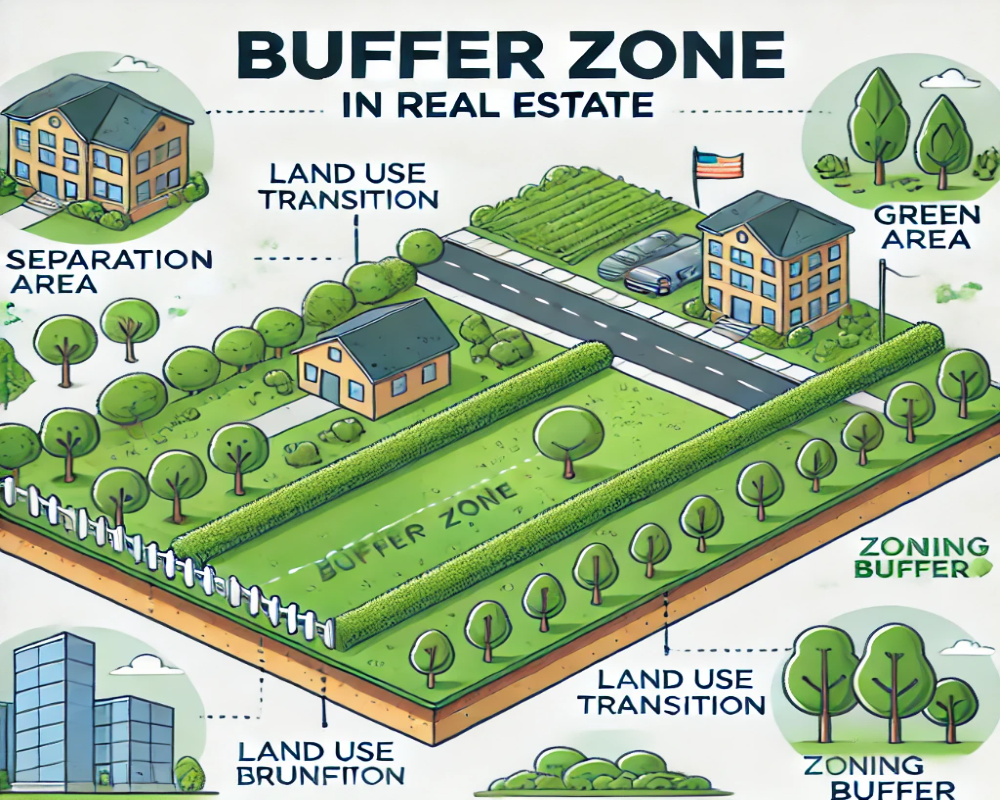
Wind-resistant garden zoning with buffer zones and protected areas
Effective wind-resistant design uses zoning: Wind edge (full exposure) → Buffer zone (dense planting) → Calm core zone (protected seating). This creates a gradient of protection.
Pro Tip:
Place your most used spaces (seating, dining, lounging) in the protected zone, and use buffer planting to shield them from wind. The high wind zone can be left as open lawn or low-maintenance planting (e.g., wind-tolerant grasses).
Zoning Rules of Thumb:
High Wind Zone:0-5% of garden (exposed edges)
Buffer Zone:10-20% of garden (transition areas)
Protected Zone:75-85% of garden (usable spaces)
🚶 9. Pathway Design in Windy Environments
Paths can either increase or reduce wind impact. In windy gardens, pathway design is crucial for comfort and usability.
Wind-Friendly Pathway Strategies:
| Strategy | How It Works | Effect | Best For | Example Plants/Materials |
|---|---|---|---|---|
| Curved Paths | Disrupts straight airflow, forces wind to change direction and slow down | Reduces wind speed by 30-50%; breaks up gusts; creates visual interest | Main pathways, garden tours, connecting different zones | Gravel, pavers, decomposed granite, liriope borders |
| Sunken Pathways | Path is lower than surrounding grade, naturally sheltered by earth berms or walls | Lowers wind exposure at pedestrian level by 50-70%; creates intimate feel | Formal gardens, high-wind areas, privacy routes | Stone, brick, concrete, groundcovers on slopes |
| Screened Corridors | Lined with vegetation or screens on one or both sides to filter wind | Filters wind while maintaining openness; reduces speed by 40-60% | Side yards, connecting paths, urban gardens | Hedges (privet, bougainvillea), lattice screens, trellises with climbers |
| Staggered Planting Borders | Plants of varying heights along path edges to disrupt airflow | Creates uneven surface that slows wind; adds texture and depth | Garden paths, borders, edges | Tall grasses, shrubs, perennials in layered arrangement |
Path Airflow Diagram:
🚶 Straight Path
Wind acceleration
🌿 Curved Path
Wind diffusion
Straight paths accelerate wind, while curved paths diffuse it, creating a more comfortable walking experience.
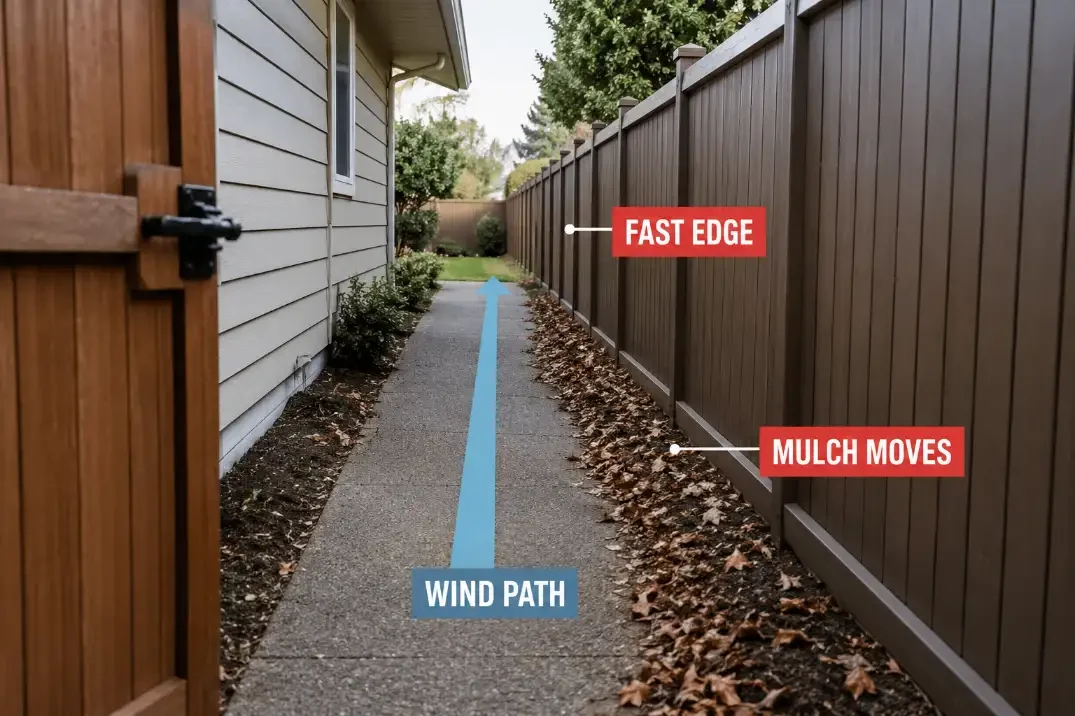
Wind tunnel effect in a straight garden pathway
The wind tunnel effect: Straight pathways between buildings or fences can accelerate wind speeds by 2-3x, making them uncomfortable and damaging to plants.

Curved garden pathway reducing wind speed through diffusion
Curved pathways disrupt straight airflow, reducing wind speed by 30-50% and creating a more pleasant walking experience.
Pro Tip:
Avoid straight paths in windy areas—they accelerate wind and create uncomfortable corridors.
Use curved or staggered paths to disrupt airflow and slow wind speed.
Line pathways with vegetation (e.g., hedges or tall grasses) to filter wind at pedestrian level.
Consider sunken pathways in high-wind zones for maximum protection.
🌡️ 10. Microclimate Creation Through Wind Control
Wind control directly affects microclimates in your garden. By managing airflow, you can create stable, comfortable pockets that extend usability and improve plant health.
How Wind Control Improves Microclimates:
| Factor | Effect of Wind Control | Benefit | Example |
|---|---|---|---|
| Reduced Wind | Higher humidity retention in soil and air | Less water loss from plants and soil; healthier vegetation; reduced irrigation needs | Protected seating areas stay lush and green with 30-50% less watering |
| Vegetation Layering | Creates cooler air pockets through evapotranspiration | More comfortable seating areas; extended outdoor season by 2-3 months | Layered planting can lower temperatures by 5-10°C in sheltered zones |
| Protected Seating | Longer usability in various weather conditions | Spaces can be used in more seasons and weather conditions; increased property value | Pergola with side screening allows use in wind, rain, and sun |
| Controlled Airflow | Stabilizes plant health by reducing stress | Reduced stress on vegetation; better growth and flowering; less maintenance | Windbreaks reduce plant water loss by 40-60% |
| Dust Reduction | Minimizes dust and debris in the air | Cleaner outdoor spaces; less maintenance; better air quality | Groundcovers and dense planting trap dust particles |
Microclimate Diagram:
Wind control creates a gradient from exposed to protected, resulting in a stable, comfortable microclimate.
❌ 11. Common Mistakes in Wind-Resistant Design
Even with good intentions, wind-resistant design can fail if common pitfalls aren’t avoided. Here are the most frequent mistakes and how to fix them:
Common Wind Design Mistakes & Fixes
| Mistake | Result | Why It Happens | Fix |
|---|---|---|---|
| Blocking wind completely | Turbulence and discomfort | Using solid walls that create strong eddies and swirling winds on the leeward side | Use permeable barriers (40-60% open) like layered plants or perforated screens for smooth airflow |
| No plant layering | Poor airflow control | Relying on a single row of trees or shrubs that doesn't effectively slow wind | Layer trees + shrubs + groundcovers to gradually reduce wind speed and prevent turbulence |
| Wrong tree placement | Wind funneling | Planting trees in a straight line that channels wind through the garden | Stagger tree placement in offset rows; use curved or zigzag patterns to disrupt airflow |
| Ignoring site direction | Structural damage | Not accounting for prevailing wind direction when placing barriers and structures | Map wind patterns; place barriers perpendicular to prevailing winds; orient structures accordingly |
| Exposed seating areas | Low usability | Placing patios, benches, or dining areas in unprotected, high-wind zones | Locate seating in protected zones behind windbreaks; use pergolas or screens for additional shelter |
| Using non-wind-resistant plants | Plant failure | Choosing delicate species that break or dehydrate in windy conditions | Select wind-tolerant species with strong stems, deep roots, and small or leathery leaves |
| Straight pathways | Wind acceleration | Creating wind tunnels that accelerate airflow and make paths uncomfortable | Use curved, staggered, or screened pathways to disrupt and slow wind |

Wind-damaged garden showing the results of poor planning
The consequences of ignoring wind: Broken branches, dehydrated plants, and eroded soil are all signs of poor wind planning.
Pro Tip:
If your garden feels uncomfortable or plants struggle, it’s likely due to one of these issues:
Solid barriers creating turbulence.
No layering in plantings.
Wrong placement of trees or structures.
Exposed seating in high-wind zones.
Straight pathways accelerating wind.
Diagnostic Questions:
Are there areas where wind feels stronger? (Likely a wind tunnel)
Do plants lean permanently in one direction? (Sign of consistent wind exposure)
Is soil eroding or dust blowing around? (Need groundcover stabilization)
Are seating areas unused on windy days? (Need better protection)
🏡 12. Real-World Wind-Resistant Garden Example: A Coastal Kenyan Home
Let’s apply these principles to a real-world example—a coastal home in Mombasa with strong, consistent southeasterly winds, sandy soil, and a need for comfortable outdoor living spaces.
Wind-Resistant Garden Layout for a Mombasa Coastal Property
| Zone | Wind Strategy | Wind Exposure | Key Features | Plants/Structures | Notes |
|---|---|---|---|---|---|
| Ocean-Facing Boundary | Dense tree belt | Full exposure | Primary windbreak, privacy, noise reduction, salt spray protection | Casuarina, cypress, neem | 3 rows of staggered trees; evergreen for year-round protection; salt-tolerant species |
| Side Buffer Zones | Shrub buffer | Reduced exposure | Secondary filtering, visual interest, wildlife habitat | Bougainvillea, hibiscus, duranta, murraya | 2m wide belt; mix of flowering and evergreen shrubs; drought-tolerant |
| Central Lawn | Moderate airflow | Sheltered | Open space for play, visual relief, and circulation | Couch grass, vetiver grass, clover | Wind-tolerant grasses; deep-rooted to prevent erosion; low water needs |
| Seating Area | Pergola with side screening | Protected | Primary outdoor living space, dining, relaxation | Timber pergola, louvered sides, jasmine climbers | 3m x 4m structure; adjustable louvers; fragrant climbers; shaded and wind-protected |
| Pathways | Curved, plant-lined | Filtered | Comfortable circulation, connects zones, prevents wind tunnels | Gravel paths, liriope borders, occasional benches | 1.5m wide; gentle curves; lined with low shrubs for wind filtering |
| Vegetable Garden | Windbreak fence + shrub buffer | Sheltered | Food production, easy access, protected microclimate | Reed fence, passion fruit trellis, tomatoes, peppers | 50% permeable fence; climbing plants for additional filtering; raised beds |
| Pool Area | Low windbreak + pergola | Protected | Reduces evaporation, prevents debris in water, comfortable lounging | Low hedge (duranta), pergola with fabric shade | 1m high hedge; pergola with retractable sides; wind-resistant materials |

Coastal Kenyan garden with wind-resistant design
A well-designed coastal garden in Mombasa uses layered windbreaks, curved pathways, and protected seating areas to create a comfortable, functional space despite strong winds.
Design Features Explained:
Ocean-Facing Boundary:
Casuarina, cypress, and neem trees form a 3-row staggered windbreak to block prevailing southeasterly winds.
Evergreen species provide year-round protection from wind and salt spray.
Salt-tolerant species are chosen to withstand coastal conditions.
Side Buffer Zones:
Bougainvillea, hibiscus, duranta, and murraya shrubs create a 2m-wide secondary filter.
Mix of flowering and evergreen shrubs adds visual interest and seasonal variation.
Drought-tolerant species reduce maintenance needs.
Central Lawn:
Couch grass, vetiver grass, and clover are wind-tolerant and deep-rooted to prevent erosion.
Low water needs make them ideal for coastal sandy soils.
Provides open space for play and visual relief from dense planting.
Seating Area:
A 3m x 4m timber pergola with louvered sides provides adjustable protection from wind and sun.
Jasmine climbers add natural wind filtering and fragrance.
Shaded and wind-protected for year-round usability.
Pathways:
1.5m-wide curved gravel pathsdisrupt wind flow and prevent wind tunnels.
Liriope borders add low-level wind filtering and visual definition.
Gentle curves make walking more comfortable in windy conditions.
Vegetable Garden:
A 50% permeable reed fencereduces wind speed without creating turbulence.
Passion fruit trellis adds additional wind filtering and edible productivity.
Raised beds improve drainage and reduce soil erosion.
Pool Area:
A 1m-high duranta hedge provides low wind protection without blocking views.
A pergola with retractable fabric sides offers adjustable shade and wind control.
Wind-resistant materials prevent damage from gusts.
Result:
A comfortable, functional, and beautiful coastal garden that:
✅ Reduces wind speed by 60-70% in protected areas
✅ Extends outdoor usability throughout the year
✅ Protects plants from wind damage and salt burn
✅ Enhances property value with attractive, well-planned landscaping
✅ Creates microclimates for different activities (dining, lounging, gardening)
✅ Minimizes maintenance with wind-tolerant, drought-resistant plants
🌪️ 13. Advanced Concept: Wind Flow Shaping
Instead of stopping wind, advanced design redirects it like water flow. This approach works with natural forces rather than fighting them, creating a more harmonious and effective garden.
Wind Shaping Strategies:
| Strategy | How It Works | Effect | Best For | Example |
|---|---|---|---|---|
| Channel Wind | Direct wind through open lawns or away from buildings using strategic barriers | Ventilates open areas; prevents stagnant air; cools hot zones naturally | Large lawns, open spaces, hot climates | V-shaped windbreaks funnel cooling breezes toward a patio |
| Deflect Wind | Use angled barriers (V-shaped, L-shaped, or curved) to push wind away from sensitive areas | Creates calm pockets; protects seating areas, water features, or delicate plants | Seating areas, patios, outdoor kitchens, water features | Angled pergola or screen deflects wind away from a dining table |
| Slow Wind | Layered vegetation (trees + shrubs + groundcovers) gradually reduces wind speed over distance | Smooth transition; no turbulence; creates stable microclimates | Buffer zones, garden edges, property boundaries | 3-row windbreak of casuarina + bougainvillea + liriope |
| Create Breezeways | Design open corridors between buildings or through gardens to encourage cooling airflow | Natural cooling; improves comfort in hot climates; reduces need for fans or AC | Hot climates, urban gardens, between buildings | Open pathway between two wings of a house channels cooling breezes |
| Combine Strategies | Use a mix of deflection, slowing, and channeling for comprehensive wind control | Most effective approach; adapts to changing wind patterns; maximizes comfort | Complex sites, large gardens, varied wind conditions | Windbreak trees deflect wind, shrubs slow it, and open corridors channel it where needed |
Wind Shaping Diagram:
Wind flow shaping: Wind → Deflection Zone → Controlled Flow → Comfort Area. This approach redirects wind rather than blocking it.
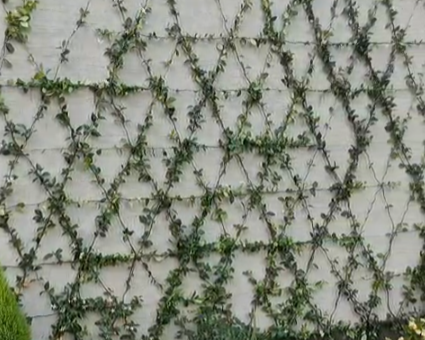
Wind flow shaping with lattice trellis fence in a garden
Wind flow shaping in action: A lattice trellis fence with climbing plants deflects and slows wind while allowing some airflow, creating a comfortable microclimate.
Advanced Wind Flow Techniques:
The Venturi Effect (Use It to Your Advantage):
Normally, the Venturi effect (where wind speeds up as it’s squeezed through a narrow space) is a problem (creating wind tunnels).
Advanced designers use it intentionally to channel cooling breezes toward seating areas.
Example: A V-shaped windbreak can funnel cool ocean breezes toward a patio.
Bernoulli’s Principle (Lift and Pressure):
Wind moving over a curved surface (like a dome or arched roof) creates lower pressure on top, which can lift lightweight structures.
Solution: Use heavy materials or anchor structures to prevent lifting.
Vortex Shedding (Preventing Vibration):
Wind passing around cylindrical objects (like poles or thin tree trunks) can create alternating vortices, causing vibration and fatigue.
Solution: Use square or irregular shapes for structures, or add dampers to reduce vibration.
Coandă Effect (Surface Attachment):
Wind tends to follow curved surfaces rather than detaching.
Use this to guide wind around buildings or through specific pathways.
Pro Tip:
Embrace wind flow shaping by:
Observing natural wind patterns in your garden (use a wind vane or ribbon to track direction and speed).
Using barriers at angles (e.g., V-shaped or L-shaped) to deflect wind rather than block it.
Creating open corridors to channel cooling breezes where needed (e.g., between buildings or through garden arches).
Combining deflection and slowing for maximum control (e.g., windbreak trees to deflect + shrubs to slow).
Conclusion: Wind Is Not an Enemy—It Is a Design Force
Wind is often treated as a problem in landscape design, but in reality, it is a powerful shaping element. When understood and controlled correctly, wind can:
✅ Cool outdoor spaces naturally – In hot climates like Kenya, controlled breezes can lower perceived temperatures by 5-10°C (9-18°F), making outdoor living possible year-round.
✅ Improve plant health and balance – Reduced wind stress leads to stronger growth, better flowering, and less water loss from evaporation.
✅ Define spatial zoning – Wind control helps create distinct areas for different activities, making your garden more functional and enjoyable.
✅ Enhance comfort and usability – A well-designed wind-resistant garden can be used in more weather conditions, extending its value and enjoyment.
A successful wind-resistant garden does not fight nature—it organizes it.
Through layered planting, strategic structures, and intelligent zoning, wind becomes not a threat, but a quiet partner in design.
🌟 Final Takeaways: Your Wind-Resistant Garden Checklist
📍 Map Your Wind:
Identify prevailing wind direction (use a compass and observations).
Note gusty conditions and seasonal variations.
Mark wind tunnels (narrow spaces where wind accelerates).
🌳 Use Layered Planting:
Primary barrier: Tall, dense windbreak trees (e.g., casuarina, cypress, neem).
Secondary filter: Medium shrubs (e.g., bougainvillea, hibiscus, privet).
Ground stabilizer: Low groundcovers (e.g., liriope, mondo grass, vetiver).
🏗️ Add Permeable Barriers:
Use 40-60% open materials (e.g., lattice screens, perforated panels).
Combine with climbing plants for natural filtering.
Avoid solid walls (they create turbulence).
🗺️ Zone Strategically:
High wind zone: Open lawns, edges of property (use wind-tolerant plants).
Buffer zone: Dense planting belts (mix of trees, shrubs, groundcovers).
Protected zone: Seating areas, dining spaces (use pergolas, screens, dense hedges).
🚶 Design Wind-Smart Pathways:
Use curved or staggered paths to disrupt wind flow.
Avoid straight pathways in windy areas (they create wind tunnels).
Line paths with vegetation for additional filtering.
🌪️ Shape Wind Flow:
Deflect wind away from seating areas.
Slow wind with layered planting.
Channel cooling breezes toward outdoor living spaces.
🌱 Choose Wind-Resistant Plants:
Strong stems (e.g., bamboo, casuarina).
Deep roots (e.g., neem, cypress).
Small or leathery leaves (e.g., bougainvillea, duranta).
Drought-tolerant (to handle increased evaporation).
Your garden’s comfort is waiting in the wind.
Start by observing wind patterns, mapping the most exposed areas, and designing layered solutions that turn wind from a nuisance into a design asset.
📌 Quick Start: 3 Steps to a Wind-Resistant Garden
This Weekend: Plant a row of fast-growing casuarina or bougainvillea on your windiest side.
This Month: Add a perforated screen or lattice panel to protect your seating area.
This Season: Redesign one pathway with curves and vegetation to break up wind flow.
💬 What’s your biggest wind challenge?
Is it gusty coastal winds? Dry season dust storms? Urban wind tunnels? Share your experiences in the comments!
P.S. Need help designing your perfect wind-resistant garden? Book a consultation and let’s create a comfortable, functional outdoor space that works with the wind, not against it! 🌬️🌳
📚 Additional Resources:
Wind Speed Measurement: Use a handheld anemometer (available online) to measure wind speed in different areas of your garden.
Plant Selection: Consult with a local nursery for wind-tolerant species suited to your specific microclimate.
DIY Windbreaks: Start with fast-growing species like bamboo or casuarina for quick results, then add permanent windbreaks as they mature.
